Katja Otto · 2 September 2026
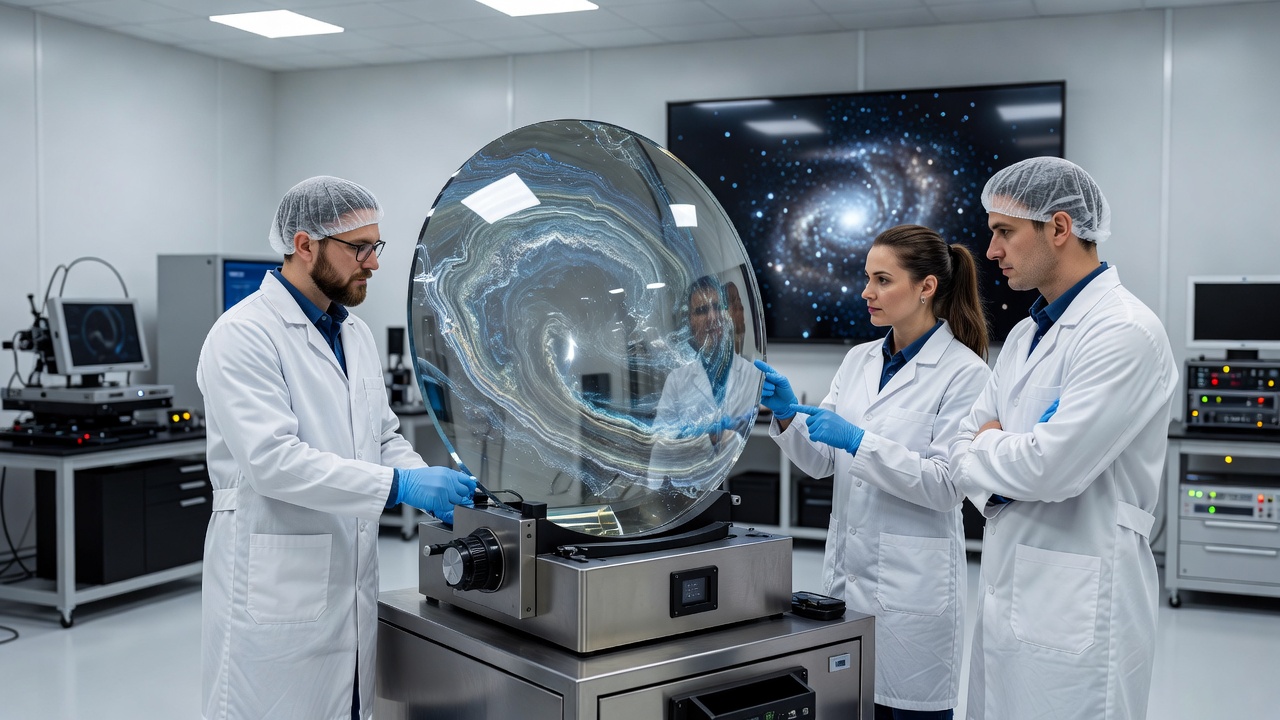
A research team at the Institute of Precision Optics in Warsaw has developed a forged lens designed specifically for deep-space telescope applications. The component uses a proprietary forging technique that improves structural integrity while maintaining optical clarity under extreme conditions.
Development Process
The forging method involves heating high-purity silica composites to controlled temperatures before applying precise pressure to shape the lens blank. Engineers report that this approach reduces internal stresses compared with traditional grinding and polishing methods. Laboratory tests showed the forged lens withstood thermal cycling from minus 150 to plus 120 degrees Celsius without measurable distortion. Surface accuracy reached lambda over 20 at 633 nanometers, meeting requirements for space-based instruments. The project received funding from the Polish National Centre for Research and Development and involved collaboration with materials scientists from the Technical University of Lodz.
Researchers emphasized that the forging process allows larger diameters without increasing weight proportionally. The prototype measures 1.2 meters across and weighs 18 percent less than an equivalent conventionally manufactured lens. Additional coatings applied after forging provide resistance to atomic oxygen and ultraviolet radiation encountered in orbit. Data from accelerated aging tests indicate the lens retains 99.2 percent transmission after simulated five-year exposure.
Applications in Astronomy
Project leads state the new lens could support future missions targeting exoplanet imaging and deep-field galaxy surveys. Its durability reduces the need for corrective optics that add complexity to telescope designs. Several European observatories have expressed interest in ground-based prototypes for adaptive optics systems. The institute plans to publish full fabrication parameters in an upcoming peer-reviewed journal and will offer limited licensing to commercial partners. Further scaling trials are scheduled for 2025 using an upgraded forging press capable of handling 1.8-meter blanks.